
How Casino Departments Should Work Together to Detect Suspicious Activity
Effective AML is a team effort. This article explores how collaboration across all casino departments strengthens the detection of suspicious activity and helps protect the integrity of the business.
AML
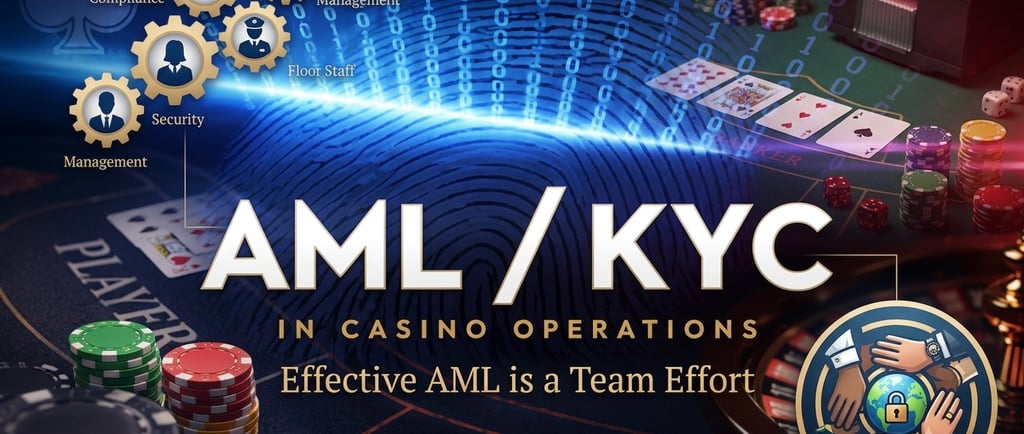
How Casino Departments Should Work Together to Detect Suspicious Activity
Money laundering is rarely uncovered through a single transaction or by one employee acting alone. It is often detected by connecting small observations made by different departments across the casino.
A player may purchase a large amount of chips at the Cage, spend very little time at the gaming tables, receive unusual attention from a VIP Host, appear on Surveillance engaging in repetitive cash transactions, and later redeem the chips with minimal gaming activity. Individually, these actions may seem harmless. Together, they can reveal a pattern that warrants further review.
This is why effective Anti-Money Laundering (AML) programs are built on collaboration, not silos.
AML Is a Shared Responsibility
Many casinos still view AML as the sole responsibility of the Compliance Department. While Compliance oversees policies, investigations, and regulatory reporting, it cannot be everywhere at once.
Every department interacts with players in a different way, giving each team a unique perspective on customer behaviour. The more these perspectives are shared, the stronger the casino’s ability to detect suspicious activity.
The goal is not to turn every employee into an investigator. It is to ensure that everyone understands what to observe, what to report, and how their observations contribute to the bigger picture.
The Role of Each Department
Cage Operations
The Cage is often the first line of defence against financial crime. Cashiers are in a unique position to identify unusual financial transactions, including:
Large cash buy-ins with little or no gaming.
Frequent chip redemptions shortly after purchase.
Attempts to structure transactions below reporting thresholds.
Reluctance to provide identification when required.
Multiple transactions conducted on behalf of another individual.
The Cage sees the money. It provides the first financial indicators.
Table Games and Slot Operations
Dealers, Inspectors, Pit Managers, and Slot Attendants spend hours interacting with players and can identify behavioural patterns that transaction records alone cannot reveal.
Examples include:
Minimal gaming despite significant buy-ins.
Passing chips between players without legitimate gaming reasons.
Unusual betting patterns inconsistent with the player’s profile.
Repeated buy-ins and cash-outs with negligible losses.
Customers who appear more interested in financial transactions than the gaming experience.
Gaming staff observe behaviour. Behaviour often reveals intent.
VIP Hosts and Marketing
VIP Hosts build close relationships with players and often possess valuable knowledge about their lifestyle, occupation, source of wealth, and expected gaming habits.
If a player’s activity suddenly changes without a reasonable explanation, hosts are often the first to notice.
Marketing departments should also understand that commercial objectives must never override compliance obligations.
A valuable customer remains subject to the same AML standards as every other guest.
Surveillance
Surveillance provides an independent view of casino activity.
Modern surveillance teams do far more than monitor cheating and security incidents. They identify behavioural anomalies, document interactions between individuals, verify transaction timelines, and support compliance investigations with objective evidence.
Video footage frequently provides the missing context needed to understand suspicious behaviour.
Security
Security personnel observe customer behaviour outside the gaming floor.
They may detect meetings in parking areas, unusual movements between entrances, repeated visits without gaming activity, or interactions that suggest coordination between multiple individuals.
These observations often complement information collected by Surveillance and Gaming Operations.
Compliance
The Compliance Department acts as the central intelligence hub.
Its role is to gather information from every department, analyse customer risk, review transactional data, determine whether activity is suspicious, and decide whether regulatory reporting is required.
Compliance connects the dots.
Without information from operational departments, many suspicious activities would remain invisible.
Breaking Down Silos
One of the greatest weaknesses in many AML programs is the lack of communication between departments.
Information remains isolated because employees assume someone else has already noticed or reported the issue.
Successful casinos encourage regular communication through:
Cross-departmental AML meetings.
Shared reporting procedures.
Clear escalation channels.
Ongoing training using real-life case studies.
A culture where employees feel confident reporting concerns without fear of criticism.
AML is most effective when information flows freely.
Technology Supports Collaboration
Technology has transformed how casinos detect suspicious activity.
Integrated casino management systems, customer risk scoring, transaction monitoring software, and surveillance analytics allow different departments to share information more efficiently than ever before.
However, technology is only as effective as the people who use it.
An automated alert may identify unusual transactions, but only operational staff can provide the context needed to determine whether those transactions are legitimate or suspicious.
The strongest AML programs combine intelligent technology with experienced professionals.
Building a Culture of Shared Responsibility
Compliance should never be viewed as an administrative burden or the responsibility of a single department.
It should become part of the casino’s operational culture.
When dealers, cashiers, hosts, surveillance operators, security officers, and compliance professionals all understand their role in protecting the business, the casino becomes significantly more resilient against financial crime.
The objective is not to create suspicion.
It is to create awareness.
Conclusion
Money laundering rarely leaves obvious clues. Instead, it leaves fragments of information scattered across different departments.
A cashier notices an unusual transaction.
A dealer observes minimal gameplay.
A VIP Host detects inconsistencies in a player’s story.
Surveillance captures repeated interactions between individuals.
Compliance pieces these fragments together.
Individually, these observations may seem insignificant.
Collectively, they can reveal the full picture.
The most effective AML programs are not built on isolated departments. They are built on communication, collaboration, and a shared commitment to protecting the integrity of the casino.
Because when every department works together, suspicious activity becomes far more difficult to hide.